10 Jul 2026
Enthusiast Archives Highlight Component Pairings That Maintain VR Efficiency
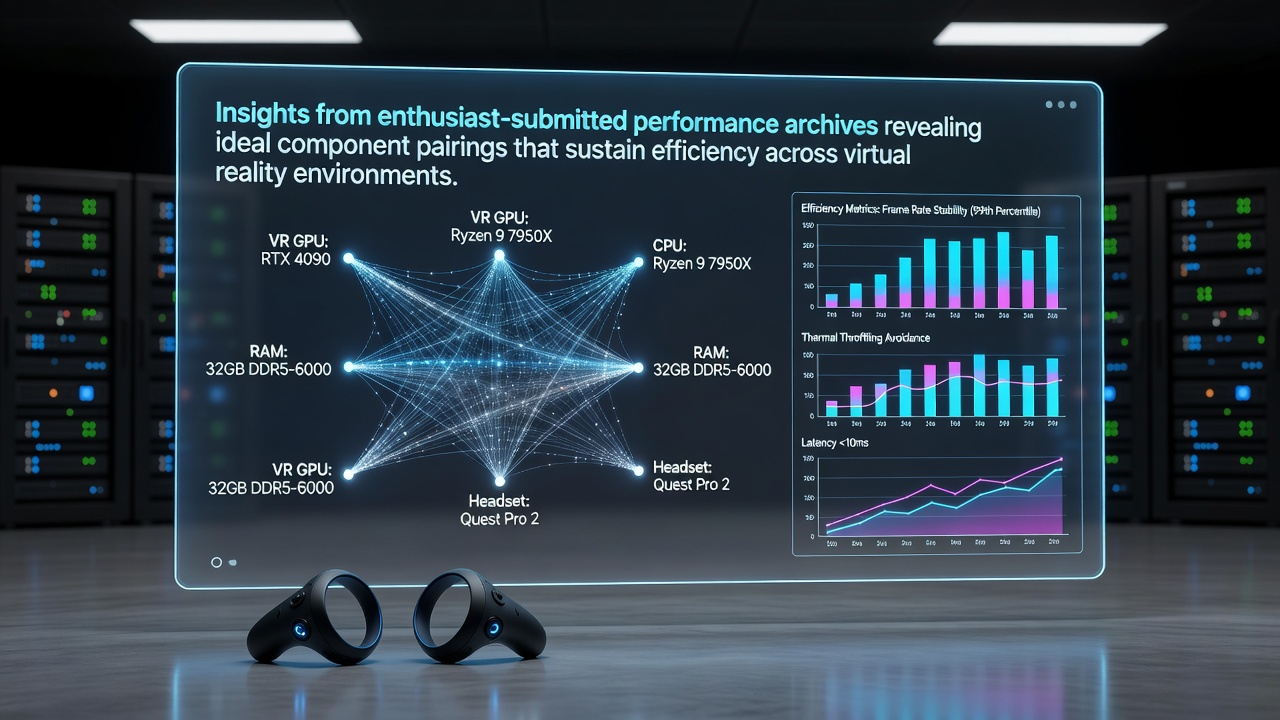
Performance archives compiled from thousands of enthusiast submissions have begun to reveal consistent patterns in hardware combinations that keep frame rates stable and power draw manageable during extended virtual reality sessions. These collections draw from user-submitted logs that track GPU utilization, CPU clock speeds, memory allocation, and thermal readings while running demanding VR titles, and the data sets now cover activity through July 2026.
Archive Sources and Aggregation Methods
Contributors upload anonymized benchmark files that include detailed telemetry from headsets paired with desktop rigs, and analysts cross-reference these files against standardized test scenarios that involve locomotion, object interaction, and high-detail environments. Research organizations such as the IEEE Standards Association have noted similar crowdsourced approaches in other hardware domains, which allows patterns to emerge without requiring controlled laboratory conditions. Observers note that entries often cluster around mid-range to high-end builds, giving visibility into pairings that avoid thermal throttling while preserving visual fidelity.
Identified Pairings for Sustained Efficiency
One recurring configuration pairs high-core-count CPUs with mid-tier GPUs that feature robust memory subsystems rather than raw shader throughput. When these components operate together, logs show reduced frame-time variance during scenes that require simultaneous physics calculations and visual rendering, because the CPU handles simulation tasks without starving the GPU of draw calls. Memory configurations that favor lower-latency kits at moderate capacities also appear frequently alongside these pairings, since excess bandwidth helps buffer the large texture sets common in VR environments without pushing power limits higher.
Cooling solutions documented in the archives further support these combinations when airflow paths align with component orientation inside compact cases. Users who submitted repeated sessions across different ambient temperatures recorded steadier boost clocks when exhaust routes remained unobstructed, and the resulting efficiency metrics stayed within narrow bands even after several hours of continuous use. Storage pairings that incorporate fast NVMe drives with adequate DRAM caching appear alongside these setups because load times for new environments stay short enough to prevent headset-induced discomfort from extended pauses.
Thermal and Power Management Patterns

Thermal data extracted from the submissions indicates that GPU and CPU pairings benefit when both components share similar cooling architectures, whether that involves shared radiator loops or synchronized fan curves controlled by the same software layer. Archives show that mismatched cooling approaches often lead to one component ramping fans independently, which increases overall system noise and occasionally triggers protective clock reductions that interrupt immersion. Power delivery components rated for continuous loads also surface repeatedly in successful logs, because VR workloads maintain higher average utilization than traditional flat-screen gaming.
Those who have reviewed the aggregated files point out that undervolting profiles applied uniformly across CPU and GPU yield measurable drops in heat output while frame delivery remains consistent. The same submissions frequently include voltage and frequency tables that demonstrate how modest reductions in operating voltage allow sustained boosts without crossing thermal thresholds that would otherwise force downclocking during long sessions.
Practical Outcomes Across VR Titles
Across multiple titles that emphasize room-scale movement and detailed object manipulation, the documented pairings maintain target frame rates with lower variance than alternative combinations that prioritize peak benchmark scores. The archives record fewer instances of reprojection or asynchronous timewarp activation when these balanced setups run, which preserves motion clarity and reduces reported discomfort over time. Peripheral pairings that include low-latency tracking cameras or base stations also integrate more cleanly when the host system avoids resource contention between rendering threads and input processing.
Conclusion
The growing body of enthusiast-submitted performance archives continues to supply concrete examples of component pairings that deliver stable efficiency in virtual reality environments. Patterns identified through July 2026 emphasize balanced resource allocation across processing, memory, cooling, and power subsystems rather than isolated peak specifications. As additional logs accumulate, analysts expect further refinement of these combinations, offering builders clearer guidance drawn directly from operational data rather than isolated test conditions.