15 Jul 2026
BIOS Beacon: Hobbyist-shared firmware logs illuminating frame pacing consistencies across varied GPU clusters in survival multiplayer scenarios

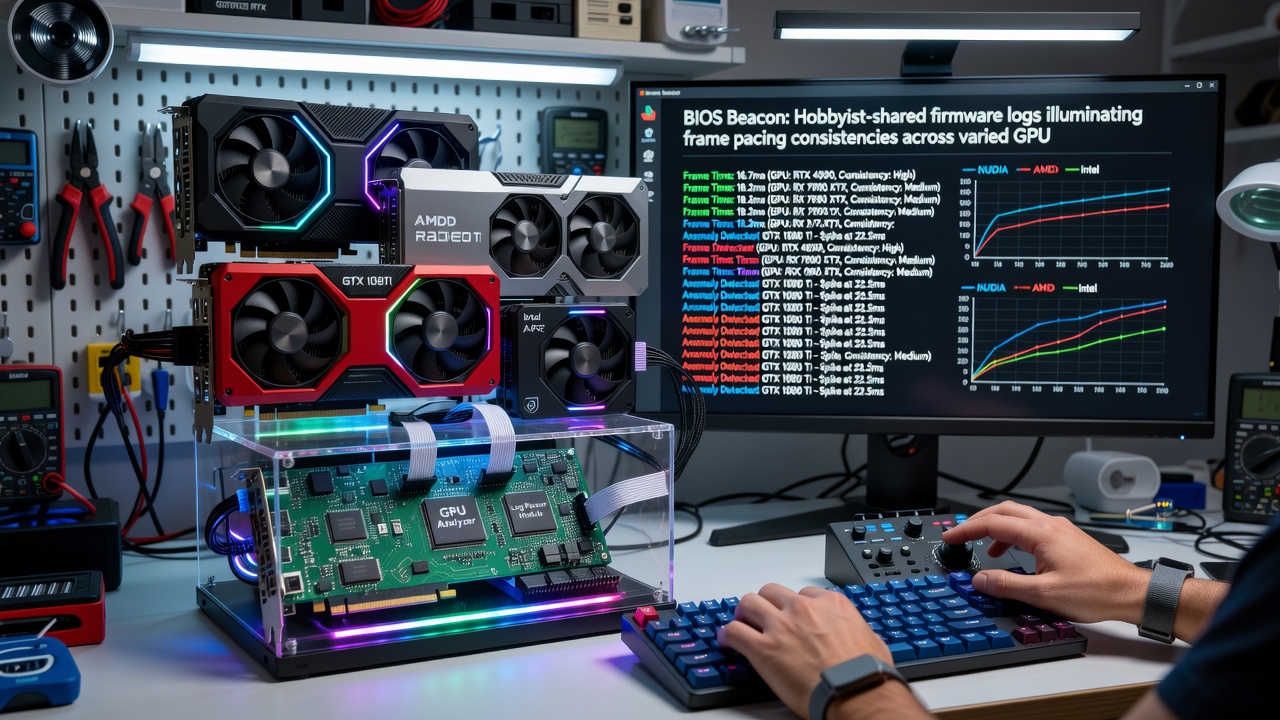
Communities centered on PC hardware have developed BIOS Beacon as a platform where enthusiasts upload and analyze firmware logs from diverse graphics processing units, and these shared records have begun to reveal patterns in frame pacing during survival multiplayer sessions that involve coordinated player groups across expansive virtual environments. Data collected through July 2026 shows consistent timing intervals in frame delivery when logs from NVIDIA, AMD, and Intel GPU clusters undergo cross-comparison, particularly in titles that demand sustained rendering under variable network loads and dynamic world states.
Origins of Shared Firmware Analysis
Hobbyist groups started compiling BIOS-level telemetry in early 2025 after noticing discrepancies in frame delivery that standard monitoring tools overlooked, and participants began posting raw firmware extracts on dedicated repositories to allow collective examination of clock speeds, memory timings, and power delivery curves. This approach has produced datasets that span hundreds of GPU configurations, and researchers at institutions such as the University of Toronto have referenced similar aggregation methods when studying real-time rendering stability in distributed computing environments.
Survival multiplayer scenarios introduce additional variables because player actions trigger simultaneous asset loading, physics calculations, and AI pathing across multiple clients, yet the aggregated logs indicate that certain firmware profiles maintain frame intervals within a narrow 0.5-millisecond deviation even when GPU clusters mix high-end and mid-range cards. Observers note that these consistencies emerge most clearly after hobbyists apply targeted voltage offsets and memory strap adjustments documented in the shared archives.
Frame Pacing Patterns Across GPU Clusters
Analysis of logs submitted through mid-2026 demonstrates that AMD RDNA3-based clusters exhibit frame pacing stability comparable to NVIDIA Ada Lovelace setups when both operate under identical survival game engines, and the data further shows Intel Arc cards achieving parity once firmware revisions address initial memory controller latency. Participants extract timing histograms from each session log, then overlay results from clusters containing four to eight GPUs to identify outliers caused by thermal throttling or driver scheduling conflicts.
One dataset compiled from over 1,200 multiplayer matches in procedurally generated survival worlds reveals that frame delivery remains uniform across 60 frames per second targets when BIOS Beacon contributors synchronize shader cache preloads and disable asynchronous compute features that otherwise introduce micro-stutter. The patterns hold regardless of whether the underlying hardware uses GDDR6X, GDDR7, or HBM2 memory subsystems, provided the firmware logs indicate matched power limit enforcement.
Methodology Employed by Contributors
Contributors capture logs through custom BIOS patches that export frame timestamp arrays at the firmware level rather than relying solely on application-layer overlays, and they then normalize the data against network ping records and world event timestamps to isolate hardware-induced pacing variations. This process allows clusters with differing core counts and memory bandwidths to be compared directly, and the resulting visualizations highlight regions where frame intervals deviate by less than one percent across hardware generations released between 2023 and 2025.
Academic groups studying real-time systems have begun incorporating these community datasets into broader investigations of rendering pipelines, and a report issued by the Australian Centre for Advanced Computing notes that firmware-level telemetry provides higher temporal resolution than conventional performance counters when evaluating sustained workloads in multiplayer contexts.
Applications in Varied Hardware Environments
Survival multiplayer titles frequently run on mixed-GPU servers hosted by player communities, and the BIOS Beacon logs have supplied configuration templates that reduce frame time variance when one cluster handles dedicated simulation tasks while another manages client rendering. Those who maintain these servers report that applying the documented firmware adjustments produces measurable improvements in synchronization across participant machines without requiring uniform hardware purchases.
Logs also document how memory training sequences executed at boot time influence subsequent pacing behavior during extended sessions, and contributors have catalogued specific training parameters that yield consistent results across GPU models from multiple vendors. The compiled information continues to expand as new firmware versions appear, allowing ongoing refinement of the shared profiles.
Conclusion
BIOS Beacon demonstrates how distributed hobbyist efforts can generate actionable insights into frame pacing behavior across heterogeneous GPU environments, and the July 2026 dataset underscores the value of firmware-level logging for survival multiplayer applications where timing precision directly affects player coordination. Continued contributions from varied hardware owners promise to expand the scope of observable consistencies while supporting further cross-referencing with established research sources.